
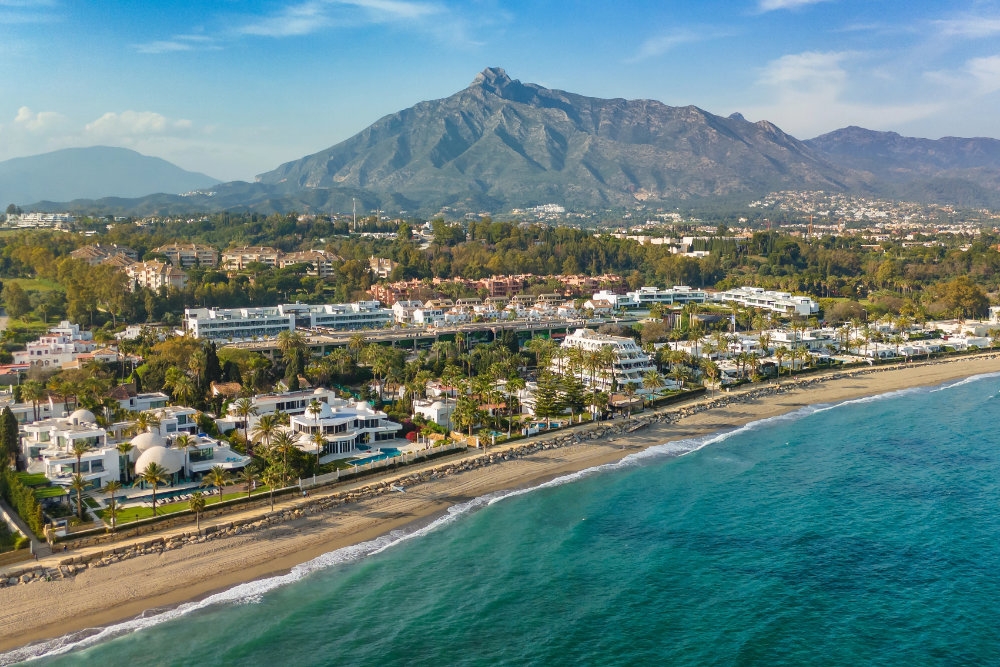
Marbella has taken an important step towards shaping the next chapter of the city’s development. The Marbella City Council has given final approval to a new General Municipal Development Plan, replacing the urban planning framework that dates back to 1986.
For property owners, buyers, developers and investors, the decision is particularly significant. Marbella has experienced extraordinary growth over the past four decades, while much of its urban development has continued to operate within a planning framework created for a very different city. The new plan is designed to provide greater legal certainty, improve infrastructure and establish a more modern framework for Marbella’s continued growth.
A new framework for 53 million square metres
The plan covers approximately 5,300 hectares of urban land, equivalent to 53 million square metres. This represents an increase of around 1,300 hectares compared with the previous planning framework. The approval follows an extensive planning process involving more than 60 reports from public authorities and sector organisations. One of the most important objectives is to create greater legal certainty for approximately 18,000 homes that have, over the years, found themselves in different forms of planning irregularity.
For Marbella’s property market, this is particularly relevant. Legal and planning certainty are fundamental considerations for international buyers, banks and investors when evaluating property and development opportunities.
Infrastructure to support Marbella’s growth
The plan is not simply about allowing more development. A central part of the strategy is ensuring that Marbella’s infrastructure develops alongside the city. Future investment is expected to include water reservoirs, distribution networks, wastewater treatment facilities and electricity infrastructure. This is an important issue for a municipality that has experienced substantial population growth as well as increasing international demand for both permanent and second homes.
The intention is to create the infrastructure necessary for a more balanced and sustainable expansion of Marbella rather than allowing development to move ahead of essential public services.
Better connections and future transport
Transport and mobility are another major part of the new planning framework. The plan identifies opportunities for new road connections between residential areas, additional parking facilities and an expanded network of cycle routes. Importantly, land will also be reserved for potential future railway infrastructure.
Protecting Marbella’s natural environment
The new framework also places greater emphasis on the relationship between urban development and Marbella’s natural surroundings. Watercourses are recognised as ecological corridors, while Marbella’s position as a gateway to the Sierra de las Nieves National Park is highlighted as an important environmental asset.
The plan also seeks to strengthen connections between the mountains and the coastline. Marbella’s seafront promenade continues to be recognised as one of the city’s most important public spaces, while additional protection is proposed for Marbella’s historical and cultural heritage. These elements are particularly important to Marbella’s long term attractiveness. The city’s international appeal has always been based on more than property development alone. Its combination of climate, coastline, mountains, golf, lifestyle and accessibility remains central to its position as one of Southern Europe’s leading residential destinations.
New housing and future development
The plan also establishes that 20 percent of land allocated within new residential developments should be reserved for subsidised housing. The newly approved framework establishes the overall principles governing Marbella’s future physical development. More detailed regulations concerning individual areas and plots will be determined through the forthcoming POU urban development plan, work on which has already begun.
For developers and property investors, this next stage will therefore be particularly important, as it will provide greater detail regarding what can ultimately be developed in specific locations.
Ending decades of planning uncertainty
Marbella previously approved a new urban plan in 2010, but it was annulled by Spain’s Supreme Court in 2015. As a result, the municipality was forced to return largely to the planning framework established in 1986. This created an unusual situation for one of Spain’s most internationally recognised property markets: a rapidly growing modern city operating under an urban planning framework created approximately four decades earlier.
What does this mean for Marbella property?
From a real estate perspective, the most important consequence may be increased predictability. Clearer planning rules and greater legal certainty can make it easier for buyers, developers, banks and investors to evaluate opportunities and make long term decisions. At the same time, the approval should not be interpreted as meaning that all land can immediately be developed. The detailed POU and subsequent planning decisions will determine what can be built, where it can be built and under what conditions.
For anyone considering purchasing land, a development opportunity or a property affected by historical planning issues, detailed legal and technical due diligence therefore remains essential. Nevertheless, after decades of planning uncertainty, Marbella now has a new framework from which to plan its future.
For a city experiencing continued international demand for high quality residential property, this represents an important milestone and one that could influence Marbella’s property market for many years to come.
Best,
Johan Mihkelson Ringqvist
CEO & Founder
Marbella Golf Estates
Ekholmsnäs Golf Lidingö
Contact:
johan@marbellagolfestates.com
+46 708 752 557
Spain Office:
Peter Jacobsen Premium Estates
Avenida Tomás Pascual 22
Club de Golf La Quinta
29679 Benahavís
Sweden Office:
Marbella Golf Estates
Ekholmsnäs Golf Lidingö
Ekholmsnäsvägen 87
181 41 Lidingö